Sunday, July 30, 2006

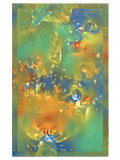
Unbound Verdant Cover

From: "barin chaki" barin_chaki@yahoo.co.in To: "Tusar N. Mohapatra" tusarnmohapatra@mail.com Subject: Re: Fw: New comment on Life and Yoga By Sri Aurobindo Date: Fri, 28 Jul 2006 14:13:19 +0100 (BST)

Dear Tusar,
I should have replied you earlier, but I was a bit disturbed and busy otherwise for the last one week, as a result of which I could not proceed ahead with my Blogs and I could not also reply you. But anyhow, finding you back, in a far greater perspective, is indeed a matter of great joy!
I have gone through your blogs and also the blog of your daughters. I liked the painting Unbound of your daughter Rimina in Panorama, one of her Blogs. The painting Verdant Cover by Silika is also beautiful.

Regarding the comment by gnat, I will post a comment later in your Blog. Thanking your for remembering me. I have began another Blog in Blogspot : The New Vision. With the best wishes, for you and for your family-members, Barin 28-07-2006 From Barindranath Chaki The New Horizon - http://www.freewebs.com/barinchaki/ , http://barin.zaadz.com

Saturday, July 29, 2006

Emphasis on abstracts is nothing but copying of European painters

In the lap of nature: Finally, there are two veteran painters who speak against the ever rising, unreasonable price tag on the paintings. Just read on as Serbjeet Singh and Vinod Sharma take stock of the art scenario today VETERANS SPEAK Serbjeet Singh and Vinod Sharma paint for passion. Everything else comes later The Hindu Metro Plus DelhiSaturday, Jul 29, 2006
They are both mesmerised by nature in its moment of perfection - a distilled, pristine purity that is fleeting as it is permanent. It beckons to them to reveal its myriad moods in a dance only they can perceive and better still, capture. It then becomes a part of their mind's eye to gush forward in a burst of joyous abandon that takes on an energy that almost spiritual in its manifestation. And yet in this abstraction is a narrative that unfolds in layers of silences.
Alka Raghuvanshi brings together artists Serbjeet Singh and Vinod Sharma whose landscapes bring the outdoors inside in an amazing interplay of light, textures and shadows. Their creative instincts have led both of them to explore the medium of film as well. Serbjeet's charming wit has us in splits as he has a million anecdotes to tell - pity he refuses to write them - of people and their quirks. Affable Vinod's frequent smile lights up his face as he talks about the restlessness that impels him to explore new vistas and traverse the extra mile.
Vinod: When people ask me as to why my focus was on landscapes for nearly four decades, I tell them it is only in India where we have some of the most stunning landscapes that we tend to take for granted - because they are there! Besides, for my love affair with nature to have lasted this long, there must be something in it!
Serbjeet: Exactly! Only in India the genre of doing landscapes is taking a backseat. This contemporary emphasis on abstracts is nothing but copying of European painters of 80 years ago! Picasso, Matisse, Cezanne have all been adopted by the various top Indian painters whose work has not grown beyond these adopted maibaaps! I remember Sanjay Gandhi got very upset with M.F. Husain for portraying his mother Indira negatively dressed!
Vinod: To me, my work is abstraction. When I see your work, I find it totally abstract. I'm not painting a tree like a photograph or even trying to reproduce it. It is a matter of perspective.
Serbjeet: True, it is a bit like Rashomon! It is a matter of your own perspective. There are times when I do white, transparent skies. Because I have trekked 25000 miles myself through the upper reaches of the Himalayas I am able to play with perspectives. I have house in Dalhousie and I would wander off in the mountains in the old British tradition of adventure for yourself - not for setting any records.
Vinod: Same here. I don't photograph landscapes, but try to experience them and then create the textures that my mind saw and my heart remembers. For textures are very important for me - having been a student of printmaking in my initial years. I find the feeling of painting on location totally different from doing it later in the studio. The immediacy has its own context.
Serbjeet: When I was making Himalaya Darshan series of films, it was such an experience to capture on camera what was part of my own mental sketchbook. You know I have made nearly 400 short films! And I will have you know that I got the Edinburgh award five years before Satyajit Ray!
Vinod: I too find film filmmaking very exciting. It is my passion. I once did the art direction of a horror film and loved it! When I am doing a film I want to be in every department - including attending the shooting!
Serbjeet: What is rather heartbreaking is that young artists are not allowed to grow. There is a waiting period of gallery booking for two years!
Vinod: I think there is a stranglehold of a few painters and the monopoly of a few is having a very negative impact on a few painters.
Serbjeet: Just as this current trend of artificially hiked rates of paintings is nothing but money laundering. When the business is of multi-crores, then it is financially unsustainable. Rich men's bored housewives throwing page 3 parties is not how a gallery is run. There are too many layers within it. In the last 10 years or so, painting has become a matter of speculation like stocks and shares. Even if you were to take it at face value, who in India will spend 10 million on a painting? It has to stabilise and then the real prices will emerge.
Vinod: It is nothing but natak baazi. Price rise of 10 to 15 per cent is sustainable. And the current trend of going overboard and raising it 200 per cent is just not sustainable. Even if I were to do it for my work, I'll feel guilty myself! Besides art must be within the reach of the middle classes as it was meant to be. In the long run, it is bad for the art if it is bought for mere investment.

Tuesday, July 25, 2006

The beauties

‘…Others finished with reincarnations and of a different over all nature, may begin the long journey leading towards the vocation of a creator. On a much different plane this could be compared to geniuses in creative fields within your physical reality. Instead of paints words, musical notes, the creators begin to experiment with dimensions of actuality; imparting knowledge in as many forms as possible-and I do not mean physical forms. What you would call time is manipulated as an artist would manipulate pigment. What you would call space is gathered together in different ways. Art is created, then, using time for example, as a structure. In your terms time and space might be mixed. The beauties of various ages, the natural beauties, the paintings and buildings are all recreated as learning methods for these beginners. One of their main preoccupations is to create beauty that impinges itself in as many various dimensions of reality as possible..’ Session 547 by Jane Roberts
posted by Augustina at 1:03 PM Reflections on practise Sunday, July 23, 2006 sethart.blogspot.com Augustina Location: London, England, United Kingdom ( Sumari/Sumari-Intermediate ) Translations of intensities and primary cordella/archetypal complexes into Art forms. Integral art practise. Depth intimacies within relationships. Focuses further complicated by issues of beauty, sensuality, eros, ritualised sex and pathways of pleasure, beyond to other sensualities including pain but all encoded as Love expressing desire for the masculine. Aesthetics. Mythologies. Psychic structures. Symbolism. Lingistics and word origins.

Sunday, July 23, 2006

Geologically made mannequins, a frontier of the Marvelous

Rocks have the incredible ability of being perceived as things they are not. In the inspired mind a simple outcome of erosion can, by chance, match the human figure, creating a fault-line in our patterned, predictable view of the world. Almost a mile south from the city of Bandon, in a remote location off the Oregon coast, is a rock formation that can easily be identified as a woman’s face in profile. Prosaically christened Face Rock by early European settlers, this mimetolith has a richer, more luminous history with the indigenous population. A Coquille Indian tale recounts the fate of Ewauna, the daughter of Chief Siskiyou, who was abducted by the evil spirit of the ocean while out for a midnight swim. Knowing the spirit’s power rest in its gaze, Ewauna defiantly refused to look in its eyes, and was tragically transformed―by the spirit or some other supernatural means it is not clear―into stone.
For evident reasons, the human face and figure are the most frequent images seen in rock formations, and to catalog such convergences of stone and shape would be a perpetual errand. However, the commonality of these apparitions does not spoil their participation in the enchantment of the everyday. Bulging with contradictions, these formations, as geologically made mannequins, obscure the line between the living and the lifeless, and redefine the limits between the hidden and the frankly obvious. If the human imagination has a connection to the natural world it is one we are forced to forget by our rational precepts. But when the repressed reaches out it forges that connection anew, making the earth with its many rocks a frontier of the Marvelous. Brandon Freels Friday, January 20, 2006 Ewuana and Her Kind 4:44 PM Flying Stone The online bulletin of the Portland Surrealist Group

Surreality in geography

Map reading as a form of interpretive delirium brings us closer to the surreality in geography. Where the Willamette and Columbia rivers meet there becomes visible the tip of a canine nose that eventually gives way to the silhouette of a coyote framed by the two rivers. This image shadows the region, stretching its chest as far south as Oregon City and flattening its ears eastward in the form of the poorly named Government Island. Known for his various adventures along these two rivers it isn’t too far-fetched to see this visual play as a likeness of the mythic Coyote, a mischievous and resourceful personage in the indigenous social fabric. And yet, given that a Colville Indian tale attributes the creation of the Columbia, in an attempt to bring salmon into the region, to Coyote himself, perhaps this image can be seen as an unconscious slip, a kind of fortuitous self-portrait by the territory’s most prolific pleasure seeker. MK Shibek and Brandon Freels The Paranoiac-Critical Coyote Flying Stone Tuesday, March 21, 2006 6:10 PM

Saturday, July 22, 2006

Sexier shows that stir excitement and draw crowds

Art Rearranged: The Shock of the New and the Comfort of the Old By ALAN RIDING NYTimes.com Homepage: July 22, 2006
PARIS, July 21 — Pity the curator in the age of the blockbuster. While art museums are usually rated by the quality of their permanent collections, it is all too often their temporary shows that stir excitement and draw crowds. Not infrequently, a work of art that is barely noticed while on permanent display is suddenly lionized in a short-term exhibition. One answer is to make the permanent collection seem, well, sexier. And to this end, some leading museums of modern and contemporary art are testing a fresh approach: if collections are frequently rearranged, either by bringing works out of storage or by changing the focus of installations, they can acquire something of the buzz of temporary shows.
“It’s something we talk about a great deal,” said John Elderfield, chief curator of paintings and sculptures at the Museum of Modern Art in New York. “How does one try to engage people with the collection as much as people seem to be willing to be engaged with temporary exhibitions?” At MoMA, Tate Modern in London and the Georges Pompidou Center in Paris, which boast the best 20th-century collections, curators have even given conceptual names to some displays to suggest they are pursuing an innovative intellectual theme rather than simply offering a lesson in art history.
“We have become more like temporary exhibitions,” said Frances Morris, who is in charge of displays at Tate Modern, which has just reinstalled its collection only six years after opening. “Temporary shows have driven the agenda for the last 30 years. It was always in these shows that new ground was being broken. I’d like to think that we are also now being experimental with permanent collections.”
“Collections are not static, so why present them statically?” asked Vicente Todoli, Tate Modern’s director. “When works are always in the same place, people say, ‘Oh, I’ve seen it already.’ You have to encourage visitors to come more than once because, with each visit, the work is viewed differently. You have to surprise and confront the visitor.”

Saturday, July 15, 2006

Forgotten awareness of a place felt to be Home

Daniel Brian Holeman Born 8:41 PM Oct. 9, 1952, San Jose, California
Artistic talent combined with life-long exploration of consciousness and devotion to self-realization has given Daniel B. Holeman an ability to depict uplifting and profound sacred imagery. His inspirational paintings have a strong impact and an uncanny affect on people. Many are deeply touched emotionally – sometimes brought to tears - and describe his paintings as the most beautiful pictures they have ever seen.
Daniel feels it is not so much the beauty as the place it stirs in people that they are responding to. He invites the viewer to dive into a deeper dimension of consciousness while viewing his paintings. The imagery stirs forgotten awareness of a place felt to be HOME – a warm, familiar and heartfelt state of mind – a welcome contrast to the day-to-day world we live in. His work has been used on TV and videos, book and CD covers, magazines, prints, posters, cards and the internet. See some samples of published works here.
Self-taught techniques include oil on canvas with airbrush touchup. The mandala works are pen and ink on paper, and then colored on computer. Rather than appealing to select markets, such as "New Age" and "Spiritual", his work appeals to a good percentage of people in all categories - perhaps anyone who appreciates or longs for that heartfelt place - thus crossing race, social, gender, religious and ethnic boundaries.
His paintings and reproductions can be seen and purchased at the InnerSpace Gallery at the Luxor Hotel in Las Vegas. His Web Site, AwakenVisions.com, is a special world to explore and enjoy - a Domain of Beauty, Insight, Transformation and Awakening. In addition to the artwork, Awaken Visions is a haven for truth seekers, consciousness explorers and all who know, don't know, or want to know what it's all about. For more information visit Spiritual Awakening. Born and raised in San Jose, Daniel currently resides in San Rafael, California and is working on a new series of inspiring abstract oil paintings.
Also see Awaken Truth Foundation Also see Daniel's Philosophy The intent of Daniel B. Holeman's artwork is to inspire people to find truth and self-realization.Daniel is also available to give talks, teachings and presentations about Awakening,Liberation as well as the artwork and what it is about. Inquire by email.

Sunday, July 02, 2006

They nevertheless deserved to be admired

Pilgrimage to an art temple in Amsterdam Sudheendra Kulkarni Indian Express : Sunday, June 04, 2006
During my school years in a small town in Karnataka, I worked as a volunteer in a public library after school hours. It was my earliest introduction to the world of books. Kannada being my mother tongue, and also the medium of study, most of the books I read were from the rich treasure of Kannada literature. And nobody had so much of a mind-expanding influence on me as Shivram Karanth, a multi-faceted literary personality and later a Jnanpith laureate. As I write these lines from Amsterdam, after spending a whole day at the Van Gogh Museum, one book of Karanth that I recall is his travelogue titled Apoorva Paschim (The Unique West).
I have been revisiting it in my mind repeatedly after visiting the Vatican Museum in Rome, the Louvre, Versailles and Rodin Museum in Paris and countless manifestations of art in the monuments and buildings during my extended stay in Europe. In this book, Karanth describes the artistic and cultural heritage of Europe with unrestrained admiration. He was especially impressed by how European countries tried to preserve their heritage during the two catastrophic World Wars. Apart from kindling my imagination about the beauty of distant Europe, what Karanth did was make me understand an important truth: even though one may dislike the West’s colonial powers for what they did to countries like India, they nevertheless deserved to be admired for all that was good and noble in them.
Vincent Van Gogh (1853-1890) is one of Europe’s many noble gifts to mankind. His name had left no impression on me in my school days. But he was to be a major discovery in my rebellious growing-up years in college—and the discovery has not ended yet. I never tried my hand at art, but like most young people radicalised by socialist ideals, I was gripped by questions—and answers—about art’s place in life, and its impact on society and politics. And Van Gogh, though he never advocated any ideology, became an inspiration to raise these questions and find answers.
What drew me to him was the book Lust for Life, based on hundreds of letter that Van Gogh wrote to his brother Theo, who was both his benefactor and his unsuccessful art dealer. In my solitary hours, I experienced an indescribable connectedness with his paintings. This befriending of the Dutch artist created an intense desire to see the famous Van Gogh Museum in Amsterdam, which houses the largest collection of his paintings (over 200), drawings and his letters. Hence, last week’s visit was in some ways a pilgrimage to a temple of art.
The use of the word ‘temple’ is deliberate. Van Gogh’s art is spiritual. If prayer or worship means a way of reverential reaching out to the Higher Power that has created this universe, and whose inter-connected attributes have been described by Indian rishis as ‘‘Satyam, Shivam, Sundaram’’ (Truth, Divnity, Beauty), then Van Gogh’s paintings have the power to draw the viewer into a spiritual journey. (He writes in a letter to Theo, ‘‘A feeling, even a keen one, for the beauties of nature is not the same thing as a religious feeling, though I think these stand in close relation to one another.’’)
Maybe the beauty of his paintings lies in the power of his colours, or in his almost disorderly brushstroke which has got uniquely identified with him. But the more you watch, the more you realise that it is not any external aspect that has drawn you in. Rather, it is the purity and sublime nature of his art. It is his love for life, but also his agonies in life. It is his paintings’ ability to make us aware of how our own existence and the society we live in have lost the self-elevating harmony with nature, and how this could be at the root of much of our sorrow, our unhappiness with ourselves, our conflicts and our dehumanisation.
For an artist who posthumously became almost a cult figure in the art world, Van Gogh lived a life of poverty, neglect and, in his later years, ill-health. This partly explains his compassion for and solidarity with the poor. He found that honesty and true religious values were more deeply rooted in peasants and workers than in ‘‘the civilised people in cities’’. One of his famous paintings is Potato Eaters, about which he writes to his brother, ‘‘...I have tried to emphasise that those people, eating their potatoes in the lamplight, have dug the earth with those very hands they put in the dish, and so it speaks of manual labour, and how they have honestly earned their food.’’
The Peasants’ Churchyard, another prized work in the museum, shows a rural church in ruins (perhaps Van Gogh’s way of bemoaning the decline of Christianity in Europe) surrounded by a graveyard bearing crosses. ‘‘I wanted to express,’’ he writes in another letter to his brother, ‘‘how these ruins show that for ages peasants have been laid to rest in the very fields which they dug up when alive. I wanted to express what a simple thing death and burial is, just as simple as the falling of autumn leaf—just a bit of earth dug up, a wooden cross...And now these ruins tell me how a faith and a religion mouldered away—strongly founded though they were—but how the life and death of the peasants forever remain the same...Religions pass away, God remains.’’
Sorrow and death are recurring themes in Van Gogh, just as serene tranquillity and springtime renewal of life are. The blue sky he painted has the soothing effect of a mother’s or a lover’s hand. At other times, it is transformed into the tempestuous swirling of clouds and stars. In each case, it mirrors infinity, and the artist’s search for the mystery of transient human existence.
Institutionalised religion troubled Van Gogh. But the life of Christ remained his ideal. To a fellow painter he writes: ‘‘Christ alone—of all the philosphers—has affirmed, as a principled certainty, eternal life, the infinity of time, the nothingness of death, the necessity and raison d’etre of serenity and devotion. He lived serenely, as a greater artist than all other artists, despising marble and clay as well as colour, working in living flesh.’’
In the world of art today, the meaning and magic of art are often obscured by constant money talk. The legacy that Van Gogh has left, however, cannot be measured by the tens of millions of dollars that each of his paintings fetch—and there are very few that get sold at all. Rather it is to be measured by the love and popular acclaim that he has won all over the world, by the good feelings and good thoughts that he sows among generation after generation of art lovers. No wonder, the Van Gogh Museum in Amsterdam attracts more than a million visitors each year. ‘‘My need to serve the people, arising from a religious calling, has now become a strong desire to leave a certain souvenir to humankind in the form of drawings and paintings,’’ he wrote in one of his letters, two years before he shot himself.
As I came out of the beautifully designed museum, with a bagful of Van Gogh souvenirs purchased at the gift shop, my eyes were drawn to a line, engraved in large letters in dozens of different languages, at the entrance. It read: ‘‘Go to the museum as often as you can—Van Gogh, 1883.’’ To me it meant, ‘‘Go to Temples of Art as often as you can.’’ write to sudheen.kulkarni@expressindia.com editor@expressindia.com

Originality plus technique

Choosing art of the future Suneet Chopra The Financial Express Sunday , July 02, 2006
When we talk of the market, we are merely talking of signposts that give one an inkling of the art of the future, Today’s signposts are the Rs 1 crore-plus artists like MF Husain, SH Raza, FN Souza, VS Gaitonde, Tyeb Mehta and Akbar Padamsee. I have chosen this sequence of names primarily because they belong to the same trend and were members of the Bombay Group as well as of the Progressive Artists Group.
The essence of their success was that they were “progressives.” That means they were committed to creating an art that represented a break with that of our colonial past or with revivalist art. They saw themselves as the path-breakers of the future and made common cause with other artists who were like-minded. But the Bombay Group based in Mumbai was not the only such group. There were progressive artists in Kolkata like Somnath Hore, Paritosh Sen, Nirode Majumdar and Rathin Moitra. In Tamil Nadu one had artists like KCS Panicker and Haridasan. In Srinagar too, SH Raza founded a group out of which the artist GR Santosh emerged.
Not all of these artists command the market as the luminaries of the Bombay group do. Nor do all artists of the Bombay group command the same high prices. Both Ara and Bakre are examples of this. So, while being a “progressive” artist has its plus points, there is more to successful art than that. Artists who are original fare better than those who are not. So when a collector chooses a work of a particular artist, he or she must see if the work marks a break from the artist’s general body of work and not merely representative of it.
It is this originality of approach that marks out artists like VS Gaitonde and Akbar Padamsee, especially the non-figurative works of both of them. In the same way, both Raza and Santosh evolved a break from our traditional “tantric” art and brought its symbolism forward in a modernist frame. Artists like Tyeb Mehta and FN Souza, apart from their progressive and original credentials, were also masters of technique. And this shows in their work. That is why their art survived the past and is likely to go into the future.
When we look at younger artists today. We have to evaluate their capacity to come to terms with the changing world and look beyond it. We must look at their capacity to handle technique and their success in breaking away from the past without resorting to copying Western avant-garde, contemporary or post modernist art. Their tryist with the future must be theirs and no one else’s. I am purposely not naming names here. I expect art lovers to internlise the rules of thumb outlined above and do the exercise for themselves. The experience ought to be rewarding.

Tuesday, June 27, 2006

Abstract Expressionism

Abstract art is an experimentation deconstructing the realty as often termed realism. At times it starts with reality and by simplifying or exaggerating it moves on to acquire its own identity totally independent of the original inspiration. It may not also draw inspiration from any real form or subject and reflect an artist’s realisations at a given space and time. The major schools of abstract art have been, Cubism(Picasso, Braque), Neoplasticism(Mondriane) and Abstract Expressionism(Thomas Rothko, Jackson Pollock). The paintings of Deb Sanjoy Dutta are experimentations in Abstract Expressionism.

Sunday, May 28, 2006

soiled, senile, rank, sordid

Keeping it surreal The Back Half Ned Denny Monday 15th May 2006
In the 1920s Georges Bataille's art magazine Documents embraced all that was "soiled, senile, rank, sordid" in western civilisation. Its radical message is as fresh as ever, writes Ned Denny
What place does surrealism, once the most insurrectionary of modernist art movements, have in our brave new world of laptops, "passionate" sandwiches and CCTV? In the first Surrealist Manifesto of 1924, the group's self-appointed leader, André Breton, called for the liberation of desire and asserted the magical power of dreams. He argued that if we all unshackled the vital energies of the subconscious, not just in art but in our lives, the grim spectre of 19th-century humanism would be banished for good. According to some, you have only to look around at our virtual, prodigious and ever-transforming landscape to see the ubiquity and triumph of the surrealists. Conversely, a recent article in the Observer contained the peculiar, dry-as-dust statement that "the relevance of surrealism . . . is generally agreed to be at an all-time low" (but relevant to what, and agreed by whom?). In fact, these seemingly opposed positions both contain an element of truth.
One cannot deny the dazzling bizarreness of contemporary life, yet this represents not freedom, but the manner in which industrial society turns the imagination to its own conformist ends. Far from having been liberated, the "rational" but pathologically destructive culture that the surrealists opposed with their calls to poetry and love has become more neurotic and impervious to change. In this regard, One-Dimensional Man, Herbert Marcuse's analysis of advanced societies, was prescient. Like all subversive currents, the surreal has become window dressing, in a world characterised more than ever by "the need for stupefying work where it is no longer a real necessity; the need for modes of relaxation which soothe and prolong this stupefaction; the need for administering such deceptive liberties as free competition at administered prices, a free press which censors itself, free choice between brands and gadgets".
If surrealism can safely be dismissed as irrelevant today, that is because its defeat has been almost total. Absorbed into a way of living whose end is a bland narcosis, André Breton's "convulsive beauty" has become an advertiser's gimmick. In this somewhat dispiriting light, the Hayward Gallery's latest show on the surrealists is nothing if not timely. First conceived after the gallery's "Dada and Surrealism Reviewed" exhibition of almost 30 years ago, "Undercover Surrealism" pays homage to the movement's most uncompromising provocateur: Georges Bataille (prudently, Microsoft Word advises that I change his name to "Bastille"). Bataille was temperamentally opposed to the dreamier aspects of orthodox surrealism, despising what he saw as the latent idealism of Breton's project. He despised everything, in fact, that gave it an obscure kinship with the progressive civilisation it claimed to reject.
Bataille thus stayed closer to the surrealists' roots in Dada, that primal howl which rose out of Zurich in the depths of the First World War. The black soil to surrealism's wildly exotic flower, Dada prescribed strange chants and the ancestral throb of drums as remedies for a culture engaged in ritual self-slaughter. Enlightenment and the march of reason having led to a mass grave (both literally and psychologically), Dadaism sought a solution in the healing powers of so-called darkness. In many respects, Bataille's Documents magazine - the central focus of "Undercover Surrealism" - was a continuation of the Dadaist onslaught against cultural somnambulism. In it, he wrote that "horror alone is brutal enough to break what is stifling", a statement that communicates the essence of his aesthetic. If the European mind had indeed become a "whited sepulchre" (as Marlow describes the unnamed city in Conrad's Heart of Darkness), cracking it open would require formidable tools. This is why, for example, Documents carried a gruesome series of photographs taken in the abattoirs at La Villette.
Bataille saw the modern abattoir as a direct descendant of the sacrificial temple, albeit one bereft of any sacred dimension. With the killing of animals not only secularised but carried out behind closed doors, people now occupied "an amorphous world where there is nothing horrible any longer". The result? A numbed and abstracted consciousness which, paradoxically, ushers in the industrial-scale sacrifice of technological warfare. The "nature" photography that Documents reproduced had the same function: to shock the mind into a clear-headed (or perhaps simply fearful) perception of reality. An oddly angled close-up of a lobster's claw seems at first glance to be a portrait of a monstrous, evil-eyed parrot. Similarly, Karl Blossfeldt's images of alien-like plants militated against a sentimental view of the natural world. As Bataille wryly notes, "Even the most beautiful flowers are spoiled in their centre by hairy sexual organs." Such intuitions of a fundamentally vile and rapacious nature linked closely with the art of the Gauls, another of Bataille's fascinations.
In his essay "The Academic Horse", published in the first issue of Documents, he examined how the noble steeds of classical currency were transformed on Gaulish coins into frenzied, ravening, insect-like beasts. The Gauls had "calculated nothing, conceiving of no progress and giving free rein to immediate expressions and violent sentiment". They were thus part of that same anarchic lineage that had more recently found expression in the formal shatterings of cubism, a style of painting he described elsewhere as being "maximally incompatible with social stability". Botanical photographs, ancient coins, modern art - all mingled in Documents with reviews of the latest jazz, the un-expected juxtapositions blowing away the stale air of conventional scholarship. Bataille's love for the rhythms of black music is another link with the Dada poets, who "would have liked to drum literature into the ground".
Even more than the comparatively jaunty Duke Ellington, the sparse pulse of the Ethiopian earth-drum was a key to the mysteries of African art. Here Bataille shows his kinship with the savage pessimism of Arthur Rimbaud's A Season in Hell, a holy text for the surrealists. Identifying not only with his pagan Gaulish ancestors but with the downtrodden "nigger" of the colonies, Rimbaud had commanded: "No more words . . . Shouts, drums, dance, dance, dance!" And then, abruptly: "The white men are landing. Cannons! Now we must be baptised, get dressed, go to work." Just like the frantic horses on Gaulish coins, tribal masks had long been regarded by European art historians as "degenerate" attempts at classical serenity. Bataille, however, perceived that they bore witness to an overwhelming Dionysian force, one that might reconnect modern man with the long-neglected gods.
There has been a tendency to paint Bataille as a sort of Jekyll-and-Hyde character, an unassuming librarian who, by night, turned into the "excremental philosopher" of popular notoriety. This is true up to a point, but misleading when it does not recognise that the antithesis is not personal, but cultural. If we spend our days in the hushed, book-lined chamber of conceptual thought, the energies we suppress are bound to resurface in frightening or destructive forms. What distinguishes Bataille is not his perversity, but his recognition of the tough measures needed to cure a perverse situation. Shunned by mainstream surrealism for his attraction to all that is "soiled, senile, rank, sordid", Bataille saw that we can no more be healthy without embracing darkness than a tree be loath to dirty its roots by placing them in the ground. In a world moving further away from the shadowy yet nourishing earth, this insight is more urgent than ever. "Undercover Surrealism" is at the Hayward Gallery, South Bank, London SE1 (0870 380 4300) until 30 July. [http://www.hayward.org.uk] This article first appeared in the New Statesman.

Sunday, May 14, 2006

Role of Indian aesthetics in contemporary art

Most galleries in New York and London are filled with art that is quite neurotic
It almost seems that fine art has been appropriated by the socially disaffected
Best Of Both Worlds By SHAKTI MAIRA timesofindia.com 13 May 2006
These are times when cultural boundaries are becoming increasingly porous. The movement of goods, information, people and ideas has reached a level that suggests that the global village imagined and predicted in the last century is rapidly forming, though what we are getting is more a global shopping mall with an attached cineplex than a village. In this global culture, though people may live as far apart as New York and New Delhi, their cultural predilections are becoming similar. They watch the same films and television programmes, wear similar clothes, fantasise about the same cars, and think art should be made in the same way and for the same reasons as by the avant-garde artists in London and New York.
In today’s art world, critics and opinion-makers usually look down on anything that is pleasing, beautiful, and not ‘concept’ art. In fact the word ‘aesthetic’ has become a negative, and in the West, contemporary Indian art has been considered less evolved because it is seen as being stuck in trying to be beautiful and pleasing. This raises some questions. Should we accept what art has been made into in the West, and change our art and make it less beautiful? Is it true that all art that is beautiful is underdeveloped?
Most galleries in New York and London are filled with art that is quite neurotic. It almost seems that fine art has been appropriated by the socially disaffected. Surely there is more to life, and, therefore, for art to express than only rejection, anger and neurosis. What about pleasure, love, kindness, joy, peace, balance, and qualities of compassion and transcendence? In the world of art there seems to be a tension, even a schism, between those who believe art must focus on social transformation and those who believe art has a vital role to help people make contact with inner realities — to even momentarily experience the transformation of deeper consciousness. The latter was the central purpose of art in Indian aesthetics.
Both these voices in art are valid and each has its place as a ‘transformer’. Through art we need consciousness-raising on social issues, and we also need the consciousnessraising that leads to a realisation of our inner potentiality for ananda. We need both the art of protest and the art of joy. It is becoming apparent that the emerging global culture and its art is the product, not of the intertwining and melding of the best of different cultures, but of the domination of a particular culture that has its roots in the history of a few European countries and the US. The dominant forms of art in the West are the result of a set of ideas, concepts, values and beliefs that are neither rooted nor always relevant in India.
Art in India was never underdeveloped. It has strong roots that stretch back into the Stone Age that are still alive. Rich traditions formed in all the visual arts. In sculpture there was an immense outpouring across India that started in Mathura and Gandhara schools between 3rd century BC and 2nd century AD. In painting, there were the frescoes of Ajanta and paintings of the western and eastern schools of illumination, and later, Rajput and Mughal miniatures. In all these arts there was a continuity and also graceful change caused by earlier forms of globalisation that occurred through trade, explorers and settlers until British colonisation, when Indian art suffered a major discontinuity in its purpose and practice and a diminishment of respect of its ethos.
Attempts to shed the colonial burden and re-establish continuity found expression in the Bengal School and during the early post-Independence years. Energetic artists consciously made art that was neither revivalist nor purely western, though often influenced by western art movements. Now, with the increasing pulls and pressures of globalisation, there is concern for the shape that Indian art will take. The choice we must make is to develop our own art by reconnecting with, and seeking nourishment from, our aesthetic philosophy and not imitate current western art and aesthetics for three reasons.
  • First, all is not well with the arts in the West. They have largely become an elite specialisation. These societies have been emptied of art in daily living and the art being made is largely narrow and conceptual.
  • Second, the need to bring beauty and the aesthetic values of balance, rhythm, harmony and proportionality into art and all aspects of everyday life such as economics, education, city planning, architecture and product design.
  • Third, India’s aesthetic traditions offer an important transformational vision and purpose for art, something we can bring to the emerging global cultural banquet.

In this, there is an exciting possibility for a new integrative art movement which drops the dualistic paradigms of tradition versus modernity, East versus West, mind versus body. This would be a contemporary art that is neither leaping blindly towards the new, nor lazily leaning back towards the old, but is centred in the eternal. It would be a radical departure from the current art ideologies, and equally relevant in New Delhi and New York, London and Lagos, Tokyo and Tehran, Moscow and Mombassa, Beijing and Baghdad, and everywhere in between. The writer is an artist and author of a book on aesthetics.

Wednesday, April 12, 2006

At Berlin Biennial, Art Fits Anywhere

By STEVEN HENRY MADOFF NYTimes.com: April 11, 2006
BERLIN — During the opening weekend of the city's fourth biennial, some 7,500 international art patrons milled up and down Auguststrasse, a storied street in the former East Berlin that starts poetically at one end with St. Johannes Evangelist Church and terminates at the other with the Old Garrison Cemetery. But visitors were not simply making their way to and from a museum or some smartly retrofitted warehouse, the usual location for a big contemporary art survey. They were waiting in the cold spring air to enter private apartments, an office, a ballroom, a shuttered school, a former horse stable, the church, the cemetery and the white-walled galleries of the Berlin Biennial's organizer, the KW Institute for Contemporary Art.
Inside this unusual array of sites, on peeling walls in several cases, or in someone else's living room, they viewed works that ranged from ominous — Mircea Cantor's chilling video of a deer watched by wolves inside a stark white gallery; Robert Kusmirowski's reproduction of a boxcar headed for the concentration camps — to droll, like Aneta Grzeszykowska's deadpan family photo album, from which she digitally removed every single image of herself. The biennial, which runs through May 28, was a focus of intense art-world curiosity in the months before its opening in late March — not least because this year's curators, Maurizio Cattelan, Massimiliano Gioni and Ali Subotnick, are art stars in their own right.
Apart from his renowned and darkly ironic artworks, Mr. Cattelan is internationally known for his curatorial partnership with Mr. Gioni and Ms. Subotnick, which famously spawned The Wrong Gallery, a sardonically named tiny exhibition space that closed last July in Chelsea. (It moved on to the Tate Modern in London for a three-year run.) Together, the three publish books and articles, give lectures, open their nomadic galleries and organize exhibitions on both sides of the Atlantic.
The question in the art world was, What would they do? Something clever and subversive? There was every reason to believe they would when, six months before the biennial, they opened a gallery at 50A Auguststrasse with a suspiciously familiar name: the Gagosian Gallery.
"We thought the real Gagosian might close us down," Ms. Subotnick said, laughing as she sat with Mr. Cattelan and Mr. Gioni at the KW Institute the night after the biennial opened. "But he never contacted us."
By using the Gagosian Gallery's international brand name in a humble space and highly local context, Mr. Gioni said, the curators sought to "create a kind of tension between the global and the local."
This was all part of their questioning of "what a biennial can be," he said.
By rough estimate, there are now some 200 biennials around the world. With so many similar festivals filling interchangeable white galleries, their usefulness is a subject for colloquiums and dinner conversations from Venice to Istanbul to São Paolo. Are they here to capture trends or to advance artists' voices in a larger social dialogue? Do they promote international understanding or local interests? Are they bully pulpits for curators turned ideologues, or are they simply there to tap the art market's stopwatch till the next survey of hot new things draws the attention of an ever expanding universe of collectors?
With a budget of about $3 million from the German Federal Cultural Foundation and nearly two years to prepare, the curators had ample resources to come up with an answer of their own. Typically, they broke the standard biennial rules, focusing neither on new trends nor on the latest crop of artists.
"You know, we say art doesn't go bad, it doesn't rot like food," Mr. Gioni said. "Art used to be about making something eternal. Now it's about a product with programmed obsolescence, almost with an expiration date."
"But what we came to understand in Berlin were the incredible layers of history and all the different ways that artists work and show here — not just in institutions, but in temporary spaces, apartments," he said.
"We realized that we could build a show out of the whole street, with artists from many generations, a show whose spaces capture 250 years of life, not just the vacuum of a gallery's white cube, as if nothing came before."
For months the curators traveled, mostly within Germany, building up dossiers of 720 artists they had visited or had heard about before narrowing the list of participants to 84. They chose artists whose works seemed to speak in some way to the curators' emotional touchstone: a single building on Auguststrasse, at Nos. 11-13, the former Jewish School for Girls, with its history of hope and tragedy. Opened in 1930, when the neighborhood was alive with Jewish culture, it was closed by the Nazis in 1942.
Once they had negotiated the use of the building, which had become a technical high school but was closed a decade ago, the exhibition's narrative became clear, and they gave the show a literary title, "Of Mice and Men," borrowed from John Steinbeck's 1937 novel. In an interview in the exhibition's catalog, Ms. Subotnick linked the book to the mood of the show, saying: "There is definitely a certain sadness in the show, a sense of darkness, and, of course, loneliness. And Steinbeck's novel was also bittersweet, mixing the sentimental relationship with a tragic, seemingly inevitable end."
The street's varied character became the loose organizing principle for the exhibition, which is strung along Auguststrasse like a collection of tales. Though the street bursts with local histories, for the curators it also represents an overarching sense of life, from birth to death, from innocence to the burdens of experience.
If anything, the art on view is about "an atmosphere of anxiety," as Ms. Subotnick put it, both past and present. In the terrifying video "Burn," by Reynold Reynolds with Patrick Jolley, viewers watch a domestic world turned into incendiary hell. Other works have an air of ethnography and loss, of precariousness and richness, like Michael Schmidt's atlas of photographs of German life since the 1940's and Tacita Dean's "Presentation Sisters," about the fading days of a convent in Cork, Ireland.
The curators' approach was greeted largely with approval by the art crowd in Berlin.
"The sad history of the street adds enormously to the art," said Jeffrey Deitch, the New York dealer. "And unlike all of these biennials in city after city, where the curator flies in for three days, chooses 25 local artists and flies on to the next place, the curators here did their homework."
"They clearly meditated on the power of the place as a microcosm for a larger understanding," he continued, "and there's a deep sense of place here, a deep sense of the way that different environments affect the way we look at art."
Mr. Deitch added, "It should be a model for a lot of biennials to come."
"Of Mice and Men," the Berlin Biennial, continues through May 28. Information: www.berlinbiennale.de.More Articles in Arts

Monday, April 10, 2006

Step Right Up to the Anatomy Lesson

By FRANCIS X. CLINES NYTimes.com: April 10, 2006
So, what did the show's artfully skinned, well-posed human cadavers ever do for a living? And how much pure P. T. Barnum gawking underlies the sober tones of education as crowds of paying customers at "Bodies the Exhibition" move wide-eyed and close-up past the anonymous fellow posed like Rodin's "Thinker"? His skin has been peeled off to display the gorgeous complexity of muscles, vessels, organs and gray matter underlying humanity — all vividly preserved in a special plasticizing process.
Actual corpses are theatrically lighted in living color, some partitioned like puzzle pieces, others sectioned as giant slide displays. All are beyond animation and the knowledge of what has become of their own remains.
"Guy was alive, a whole person," said a wary teenager as classmates checked out the thinker. "It's not my place to stare."
But the lad did. The cadavers — 22 of them — pretty much stared back.
It's like that at the Manhattan exhibition and at a growing number of shows in cities around the globe as rival companies tap for profit ($24.50 per adult visitor) into startling new dissection techniques. Bodies become virtual performers in balletic still lifes revealing their intricate parts in living color. Filigrees of complete blood and neural systems hang like mobiles. The muscle sheaths of one posed sprinter are teased out from his back like the wings of Mercury fleeing some abattoir.
Critics fear that the scores of beguilingly tweaked bodies dispatched like vaudevillians may come from black marketeers. But purveyors insist each body comes with firm legal documentation of natural death, unclaimed and available for purchase, just as anatomy professors have obtained cadavers for years.
Public reaction is as varied and visceral as the body displays. A doctor exults at such firsthand education for the public; another thinks forensic evidence of foul play is discernible.
Living voyeurs trump the corpses as the attraction. A teacher happily lectures a class mesmerized at the palpable truth of a halved heart. At the lung display, a young smoker named Jen is gleefully summoned by her classmates to see the shiny black lungs of a dead smoker. Some pause at the message at one undone body: "It's never too late to start that workout."
But wait: that fellow extended athletically with a baseball in his flayed right hand (split-finger fastball, it seems) was allowed to keep his eyebrows for human emphasis. This invites pathos to blur the science: what's the witless man's history? Who was he really?

Saturday, March 18, 2006

Exploring the mystique of light

Santosh Verma
As Art is the exploration of the visual medium, light is the primary element for exploitation, Distinct colours, forms, negetive spaces, compositions are realised by us due to the different ways light responds to a creation i.e. the way light reflects off the creation.
Through the ages, artists have used light consciously or otherwise in their creation. Be it the glow on the face of Ajanta frescoes, the stained glass panels of the 12th century churches or even later in the works of the impressionists.Light has always fascinated me and has been my main inspiration. Light refracting from a crystal or jewel, light creating highlights and shadows and the intertwined mid-ranges on laid satin or sand dunes, light glimmering through the bunch of leaves captivate me. For nearly a decade and a half, I’ve been studying the dimensions of light on various surface, texture and objects, and have been experimenting and interpreting its play on canvas. Sunday, July 03, 2005 ¶ 7:44 AM SRB-94 B, Shipra Riviera, Indirapuram, Ghaziabad, U.P. - 201012, Ph: 0120-2606484, India

Friday, March 17, 2006

Environmental sensitivity for the design process

Golconde is also "a dormitory for the Sri Aurobindo Ashram in Pondicherry, India...designed by architects George Nakashima and Antonin Raymond," completed in 1945 and named for nearby diamond mines. This building is the subject of an exhibition (by Pankaj Vir Gupta and Christine Mueller) on display at the Graham Foundation until May 25, as well as a gallery talk on March 28 by Andy Tinucci.The building is notable for being "the first reinforced, cast-in-place concrete building in India," though Gupta and Mueller view it as "one of the earliest works of sustainable modern architecture in the world, [espousing] the virtue of radical economy and uncompromising construction standards". posted by John @ 1:00 PM

Exhibition Opening and Lecture Golconde: The Introduction of Modernism in India Tuesday, February 21, 6pmGraham Foundation, 4 West Burton Place, Chicago Extended through Thursday, May 25, 2006. Monday through Thursday from 10am to 4pm.

Sited on the coastal edge of the Bay of Bengal, Golconde, a dormitory for the Sri Aurobindo Ashram in Pondicherry, India, was designed by architects George Nakashima and Antonin Raymond. Golconde is a remarkable architectural edifice, seamlessly negotiating between the tenets of early modernist architecture while addressing the pragmatic impositions of a tropical context. Espousing radical economy and uncompromising construction standards, it proposes environmental sensitivity as a foundation for the design process. Completed in 1942, Golconde was the first reinforced, cast-in-place concrete building in India and clearly celebrates the modernist credo: architecture as the manifest union of aesthetics, technology, and social reform. This exhibition assembles construction drawings, architects' letters and journals, and extensive photographs of this extraordinary building.

Pankaj Vir Gupta and Christine Mueller are founders of the office of vir. mueller architects, which combines architectural research, education, and practice. Gupta and Mueller currently teach at the University of Texas at Austin. With Cyrus Samii, they traveled to India in 2003 to conduct research on the architecture of Golconde. Gupta has taught design studios at the Arizona State University and the University of New Mexico and is founder of Reading India , a study-abroad program that explores the architecture of ancient and contemporary India. He received his M.Arch. from Yale University. Mueller, who has lived in Germany, Switzerland, and the U.S., has taught design studios at the Boston Architectural Center and the Career Discovery program at Harvard University. She received her M.Arch. from Harvard. Copies of Nature, Form, and Spirit: The Life and Legacy of George Nakashima by Mira Nakashima are available for purchase. Back to program listing 2006 Graham Foundation

Sunday, March 12, 2006

Shiva Vangara

Shiva's basic foundation was realism and portraits. Then in 1983 when he started his quest for Truth in Sri Aurobindo Ashram, Pondicherry, India - his perception of art changed entirely and entered into spiritual dimension. He had his frist solo exhibition in Bombay at Gateway of India in 1993. Then in Sri Aurobindo Ashram and Auroville in 1995. His inspiration was "The highest art is that which by an inspired use of significant and interpretative form unseals the doors of the spirit." -The Mother.
At present he is mostly busy with his ambitious Hollywood project entitled Fourth Dimension. posted by Shiva Vangara Friday, January 27, 2006 at 7:42 AM

Friday, February 24, 2006

Dali, Munch and Picasso

I have always thought that one need not be formally trained or schooled in art appreciation to appreciate art. Dali's work, for instance, have always had a haunting feel about them and made me think for a long time after I had looked at one...frankly speaking, I can't pretend that I understand Dali, most of the while I don't, but the very fact that he makes me reflect over an unseemly agglomeration of distorted shapes, forms and objects is I think tribute to his originality of thought and of skill....I've felt the same with Munch's "The Scream", some Picassos and several African masks, dolls and idols, Yakshagana and Kathakali masks, Bali puppets, Easter island figurines...
I'm not a great fan of modern art, most of which are not within the reach of my mind; this is perhaps because each art work represents a peculiar private point of view of the artist of something or someone, an abstract viewpoint of several billion theoretical possibilities, considering one per every living person on earth and to gauge some meaning related to the artist's perspective would be a task of considerable ingenuity and insight - not, I'm afraid, everyone's cup of tea! (I’ve always felt that there are too many who pretend to understand the modern artist.)
A modern artist can only be appreciated widely if he has an original, arresting perspective which should also embody a freedom to interpretation while always being able to convey the artist's idea...its a rather tall order for asking, but I think that is why many people are captivated by Dali, Munch and Picasso rather than innumerable others (I have overlooked some practical aspects of media exposure, art circle intrigues and so on, although they may play a role, they are probably not as relevant in the current discussion...)….
Art criticism, like literary criticism, is a thoroughly individualistic perspective cloaked in apparent universality. A person puts forth an idea or feeling about an art or a literary work that might well involve a lot of insight, but would necessarily restrict a reader's outlook to the work of art or literature. In that manner, I think critics, most of whom are subjective in criticism, are dangerous in tending to curtail imagination. A successful critic would probably be more objective in his remarks and would allow for, rather, invite individual reactions and remarks from his audience. A critic of this mould is probably a rare find today...
I think Aurobindo's "Future Poetry" represents a rather good example, in riveting language and style, of an atypical Indian view of literary criticism of English poetry. Thejaswi Shivanand Location: Bangalore, India posted by Dumaketu Saturday, October 29, 2005 @ 11:43 AM 14 comments

Thursday, February 16, 2006

Perennialist Art: Psychic Upheaval and Epiphany

The distinguishing feature of Perennialist art is its power to produce psychic upheaval in a prepared mind and transport that mind to a higher dimension. I am using the term "Perennialist art" to include the conscious production or arrangement of words, sounds, colors, forms, movements, or other elements in a manner that enables a person to understand truth and beauty.
Within the term "Perennialist art," then, I include those specially created instances of literature (prose and poetry), drama (including screenplays), painting, sculpture, music, dance, or illustration (including illustrated books and Web sites) which possesses the distinguishing quality of empowering a reader or viewer to gain a higher state of consciousness. The person must have carried out specific preparation to be able to conceive of new possibilities, understand new concepts, and participate in transformative experiences. To an unprepared psyche, Perennialist art appears lackluster or bizarre.
Transformative art leads the readied psyche to dimensions higher than previously experienced, to epiphanies. These epiphanies involve inspiration, a fusing with the universe, transcending time-space-ego, infusion with knowledge and awareness, and gaining a sense of endowment. Psychic upheaval and transport to higher awareness can occur in any area of human life at a multiplicity of levels. Illuminating art has been with humankind since its beginning, leading humans in their evolutionary ascent.
Upheaval is required to displace the psyche--mind and personality--from its entrenched intellectual and emotional routines. This is not some vague feeling of uplift or emotion; it is an eruption within the soul...Perennialist art leads to human liberation in all areas of life. We understand social liberation to include some means of control of rulers by the ruled, protection of the individual against government by legal rights and civil liberties. In a broader context, liberation means the ability to make decisions and carry out purposes, free from internal and external coercion, using the powers of the psyche to develop human potentialities, some of which may be unknown until revealed by illuminating art. hermes-press.com

Wednesday, February 08, 2006

Integral Artist

Original Gravity by ebuddha on Wed 17 Aug 2005 04:44 PM PDT Permanent Link
It's now near the end of my workday, I was playing around with a couple of other new Yahoo beta tools - and I came across this site called Original Gravity. It's pretty interesting - dating from the 1980's, a collection of writing, thoughts on art, on design, photography, all based around a type of integral philosophy. Funny enough, it reminded me a bit of our intrepid budding integral artist Dan Allison's site - although this may just be the open mouth visual thing. Still, a fascinating site, really.
Almost like the "O.G" Integral Artist - a little respect y'all! Who WOULD be the O.G. integral artist? With a consciously aware philosophy of art that includes mind-body-spirit? I mean, you could go back to DaVinci, of course - that monster of mind, art and philosophy. But that would be too far back, and doesn't consciously include an integral perspective. You would have to start from after Aurobindo or Teilhard de Chardin. Any thoughts?

Tuesday, January 31, 2006

Fractal Art

By Raj Mathur Life Positive, April 1996
Pack up your easel, palette and paintbrushes. Turn, instead, to the mouse and the PC. Just a few clicks away, lies pixel art that arises from fractals or geometric figures. Fragmented, irregular and magical, it takes you to a whole new world. A world where there is beauty in form, rhythm in color, order in chaosFractal geometry was accidentally discovered about two decades ago by mathematician Benoit Mandelbrot, who was born in Warsaw, and later shifted to the US, where he worked at IBM. While plotting the imaginary values of the square root of minus one, Mandelbrot found beautiful patterns and shapes that repeated themselves in different scales-like the shape of a tree is mimicked by the branch, the branch by the twig, the twig by the leaf.
The art of fractals is both simple and complicated. Simple, because, given the right mix of software, hardware and imagination, even the guy next door can easily work at producing them. Complex, simply because if you take a fractal, zoom into a small part, and then blow it up, you find the new picture is at least as complicated as its original. The basic pattern of the fractal is repeated, but, with each repetition, the pattern differs slightly. The beauty of the whole process is that this continues however deep you zoom into the fractal. This form of art is used by musicians. It is also used by economists, geologists, filmmakers and, of course, by computer enthusiasts such as Raj Mathur who has generated the images that you are seeing here.
Compact discs of readymade fractals are readily available on the market. But Mathur works from a fractal program and a set of formulae to evoke these beautiful images. So, in a sense, he has technically generated them. He is, however, quick to give credit to the original authors of the formulae-Michael Coddington, Ian Adma, Richard Hughes, Pieter Branderhorst, Scott Taylor and Ethan Nagel. Says cyber junkie Mathur whose social life seems to be restricted to the computer: "Fractals are absolutely fascinating. If my math were better, I would have learnt more about them. But, even without math, I am quite happy to generate and view them." To view Raj Mathur's fractal art, click here.

Saturday, January 21, 2006

Where art is part of integral yoga

Satyam, Shivam, Sundaram Natalia Kravtchenko, Vladimir Zaitsev
From ancient, miraculous stones build the steps of the future. Nicholas Roerich
CULTURE OF PEACE Edited by BAIDYANATH SARASWATI 1999, Indira Gandhi National Centre for the Arts
Not only are the names of Rubens, Velazquez, Griboedov and many others immortalized in art, but also for their unforgettable advice in the field of statesmanship. Objects of art themselves very often were the best ambassadors, introducing peace and friendship. It is known that the exchange of art treasures prevented misunderstandings and was ahead of verbal agreements.
The remarkable results of art in education were proved by the experiments of Tagore in his university, Visva Bharati. All the programmes of this institution were based on unity and harmonious relationship with nature and development of the sense of beauty. A great deal of art and creativity is involved in the educational process of Sri Aurobindo Ashram, where it is considered the foundation for the intellectual and spiritual development of man. Here art is part of integral yoga and creativity is the active power in the evolution of man.
Considering the ‘culture of peace’ one should not forget the original experiments in the field of culture conducted by the great peace-builder Nicholas Roerich. At the end of the 1920s he established in the United States an international institute of art named Corona Mundi and a museum which were prototypes of contemporary academies of fine arts. Musicians, painters, poets, writers, architects, scientists were united in these creative communities under Roerich’s slogan ‘peace through culture’. Later this idea was extended in artistic activity in the preservation of cultural monuments and treasures of art. It finally materialized in the international memorandum, the ‘Roerich Pact’, signed by 54 countries in Gaag after World War II. For the first time cultural heritage was recognised not as a luxury, but as a necessary foundation for the spiritual being of mankind. For its humanism contemporaries named this project the ‘Red Cross of Culture’.
In the service of peace and spiritual principles, art and creativeness reach their highest self-expression. For the spiritually alive human being the value of art lies in its beautiful existence, in its great mystery, in its mighty transforming and purifying power (catharsis). Through art one discovers the whole universe of the human spirit, limitless spaces of human thoughts and feelings. At one moment through the charming sounds of music or rhythm of ancient chants one may be united with events going back to thousands and thousands of years ago. Art in its sublime forms and expressions gives us an opportunity of unforgettable experience, it reminds us of a different kind of reality, the origin of existence.
The process of creativity is comparable with the spiritual path (sadhana). In all fields of art meditative disciplines are a normal part of human experience and have a profound effect on artists. The insight born of these disciplines inspires a sense of participation, of identification with all life. In Russia there exists a system of inner discipline of the artist formed during the centuries. Most powerfully it was expressed in the art of icon painting.
Long before starting a painting, artist practises prayer and silence and maintains mental and emotional purity. These helped him to achieve the resonance, like a musical instrument, to be one with the subject of his painting.
There is a certain duty and responsibility of the artist towards his invisible ideal. In icon painting the main stress is on the expression of inner beauty, spiritual power, where they are considered limitless love and compassion. In the instructions to the artist we read: ‘Maintain the unity of your will. Do not listen with your ears but with the mind. Do not listen with the mind, but with the spirit. The spirit is an emptiness ready to receive all things.’
By stilling his heart, that is, shedding thoughts and emotions of his personal life, an individual can reflect on his heart-mind the power of High Consciousness (the holy spirit, tao, atman, etc.). The sense of another reality within allows the artist to find out new artistic and technical solutions. So in some old Chinese paintings one may discover that what seemed to be empty was never vacant. Obviously the artist was able to suggest aliveness in unfilled surfaces and employ empty space in ways which are extremely daring. Poetically it can be illustrated in the following lines:
Stillness — a transparent mirror for celestial reflections.
Stillness — a morning song forgotten by mankind.
Stillness — the sound of eternity amidst the cries of the earth.
Stillness — the invisible door to the silence.

Friday, January 20, 2006

Because it does not aim at being artistic

Satyam, Shivam, Sundaram Natalia Kravtchenko, Vladimir Zaitsev
From ancient, miraculous stones build the steps of the future Nicholas Roerich
CULTURE OF PEACE Edited by BAIDYANATH SARASWATI 1999, Indira Gandhi National Centre for the Arts
One would be able to reach it when the difference between mechanical civilization and the coming culture of the spirit is realized. ‘For man intellectually developed,’ writes Sri Aurobindo, ‘mighty in scientific knowledge and the mastery of gross and subtle nature, using the elements as his servants and the world as his footstool, but undeveloped in heart and spirit, becomes only an inferior kind of asura (demon), using the power of a demigod to satisfy animal nature.’ Observing the historical panorama one may find that civilization is created during a few decades, while culture is based upon achievements of thousands years.
In art of this subtlety there are qualities that go farther than naturalness or realism. The process of communication between artist and object creates specific relationships between them; the artist is much more attracted to the inner content of the subject than to its external attractiveness.
There is always difference between likeness and truth. ‘Likeness could be obtained by shapes without spirit, but when Truth is reached, spirit and substance are both fully expressed.’ Evidently, beauty does not necessarily spell perfection of form. This has been one of the favourite tricks of artists in Japan and in some Scandinavian countries — to embody beauty in the form of imperfection or even ugliness, or asymmetry. All these methods of creativity served one main desire of the artist — to reveal another nature of the subject, to express its inner cosmos.
Thus in the art of icon painting we are moved first of all by the unspeakable beauty of the artistic image, which is transformed from the personal into universal. We completely agree with the opinion of Nalini Kanta Gupta who wrote on the Upanishads: ‘Art at its highest tends to become also the simplest and the most unconventional; and it is then the highest art, precisely because it does not aim at being artistic. The aesthetic motive is totally absent in the Upanishads; the sense of beauty is there, but it is attendant upon and involved in a deeper strand of consciousness.’ Indeed, at its highest, art does not tolerate any conventionality, nor violence. In the very foundations of being lives the concept of beauty, and where there is beauty, there is peace.
In Beauty we are united!
Through Beauty we pray!
With Beauty we conquer!

Tuesday, January 10, 2006

On being an Art Critic

The highest aim of the aesthetic being is to find the Divine through beauty,” – Sri Aurobindo (Gems from Sri Aurobindo V1. by M.P. Pendit) posted by Mary Lee Pappas at 10:29 PM
A First Person on Being an Art Critic - Does Indianapolis want arts criticism?
By Mary Lee Pappas NUVO art critic spring 2005
  • Should an art critic write about artists whose work they collect?
  • Should an art critic fraternize with artists they write about?
  • Should they accept gifts from artists they’ve written about, be an exhibition consultant, sit on boards of visual arts organizations, or exhibit their own artworks?

According to “The Visual Art Critic: A Survey of Art Critics at General-Interest News Publications in America” by Columbia University’s Journalism Program in 2002, there was no consensus among the 169 art critics surveyed (myself the only Indianapolis representative) regarding blanket ethical conduct within the American art world.

This perhaps resulting from the public’s equally as uneven expectations of what art criticism ought and ought not to be. An opinionated bunch to begin with, participating art critics had to have written at least twelve ”evaluative” pieces the previous year to qualify for the survey. Those are reviews that make judgments regarding quality, purport, and context based on the work, the artist, the venue, the curatorial competence, and sometimes funding. It’s gauging art instead of strictly spouting anthems of advocacy, subjective explanations, and taking strict emotions into account.
Critics, predominantly employed as part-timers or freelance at both daily and alternative weekly papers, were actually found to be “intimately connected” to their local arts communities. Is this conflict of interest, or fundamental for the role? 24% of us had worked in museums, 18% in commercial galleries, while nearly half of us were artists – 70% of whom exhibit or have exhibited their works. 14% were employed in art-related industries. Four out of five newspaper critics and three out of four alternative weekly critics collect art. Though 90% of the critics were curiously Caucasian when multiculturalism in visual art is ever present, well preparedness for their work varied greatly.
The majority of practicing art critics had on average 13 years of journalism/art writing experience. 20% of art critics had no formal training in art or art history, while only 26% of us actually had a B.A., M.A. or Ph.D. in art history. But, apparently it doesn’t really matter who’s writing about art anymore. Some artists should, “Park their paints,” and let go of ego, pride and fickleness local painter, art historian, and gallery owner Doris Vlasek Hails said to me once. But there has been an increasing trend for artists and arts organizations across the country to steer clear of uncompromising critics and seek-out positive press thereby creating their own undeserving derivative art stars. Some buy it. As our local visual arts community flourishes so too do the proliferating and, more often than not, only moderately talented artists who Indianapolis audiences so anxiously and sometimes bafflingly accept.
  • Can anyone who can afford rent at a trendy studio be an artist?
  • Are gallery owners and proprietors actually qualified to choose quality art to present to the public just because they can fund their venues?
  • Who is drawing the line between hobby and excellence?
  • Should critics simply relinquish themselves to this laissez-fare intellect regarding the fine art process and art history thereby giving artists and venues the praise they ultimately fancy?
  • Where does criticism fit in and who really wants it anymore?

Indianapolis appears to be succeeding at placing novelty (or propaganda at times) above discrimination. The survey makes an example of our city by stating, “Citizens of significant urban agglomerations, including Indianapolis and Las Vegas…do not have the benefit of hearing from an art critic who might qualify for inclusion in this survey,” from a daily paper. This perhaps in part because formal criticism doesn’t serve the city’s desires to make Indianapolis a cultural destination overnight. However, celebrating the mundane won’t make it happen either. Though art critics across the board thought they were writing for a “lukewarm audience that is not too well steeped in the arts,” nearly two-thirds unfortunately write strictly positive reviews, with “rendering a personal judgement” about the artwork being “the least important factor in reviewing art.” It’s a sorry commentary that’s ultimately destructive of the arts evolution (like Indianapolis’ visual art growth spurt), and the art itself. So are gallery openings where the art plays second fiddle to the party.

  • Are arts writers accepting expenses on press junkets?
  • Are papers merely supposed to conform, jump on the promotional bandwagon, and be another form of advertising?

Perhaps this is an indication that some “critics” should park their pens or thicken their skin. Perhaps local media should give more space and credence to the visual arts cultures of their communities, and artists should challenge themselves to create more than attractive formula paintings accompanied by contrived statements of purpose. Local eagerness to be exceptional in the visual arts has created levels of administrative and artistic inferiority that can be remedied by demanding quality and education from those that serve the arts community, critics alike. Inferring that arts audiences and potential arts audiences are un or under educated (as is the rhetoric from artists and arts orgs.) only serves to insult and estrange audiences…as does substandard art. Friday, November 11, 2005 posted by Mary Lee Pappas at 7:31 AM