The best place to start when describing the goals of a research program is with the statements of the researchers themselves. V.S. Ramachndran, whose work on art and neuroscience has sparked a great deal of interest and controversy, put it this way1:If a Martian ethologist were to land on earth and watch us humans, he would be puzzled by many aspects of human nature, but surely art—our propensity to create and enjoy paintings and sculpture—would be among the most puzzling. What biological function could this mysterious behaviour possible serve? Cultural factors undoubtedly influence what kind of art a person enjoys — be it a Rembrandt, a Monet, a Rodin, a Picasso, a Chola bronze, a Moghul miniature, or a Ming Dynasty vase. But, even if beauty is largely in the eye of the beholder, might there be some sort of universal rule or ‘deep structure’, underlying all artistic experience? The details may vary from culture to culture and may be influenced by the way one is raised, but it doesn’t follow that there is no genetically specified mechanism — a common denominator underlying all types of art. (p. 16)The search for universals in art is by no means a new one, but Ramachandran and others (most notably Semi Zeki) have resolved to do so by understanding the neurological mechanisms that all (or most) art utilizes. Zeki writes2:What is art? What constitutes great art? Why do we value art so much and why has it been such a conspicuous feature of all human societies? These questions have been discussed at length though without satisfactory resolution. This is not surprising. Such discussions are usually held without reference to the brain, through which all art is conceived, executed and appreciated. Art has a biological basis. It is a human activity and, like all human activities, including morality, law and religion, depends upon, and obeys, the laws of the brain. (p. 53)If art, both in its creation and appreciation, is a product of brains, then it stands to reason that we may gain valuable insight into the nature of art by understanding how it acts on our brains. Specifically, we may be able to utilize our knowledge of the workings of the visual system, and its connections to emotional centers of the brain, to understand why certain themes, forms, and schemes can be found in art across cultures, and why some works of art are more aesthetically pleasing than others. In order to do this, Ramachandran, Zeki, and others have developed several hypotheses designed to produce testable predictions (often counterintuitive) about the role of the visual system in the production and appreciation of art.This project differs, markedly, from traditional approaches to art, in which art is treated as amorphous, or ineffable; a product of irreducible subjective and cultural phenomena. Thus traditional aesthetic theories are untestable by their very nature. The hope of neuroscientists is not that art will be completely explainable from neurological principles alone. On the contrary, these neurological principles are meant to be foundations onto which the more subjective and culturally relative aspects of art are built. Even if the insights that we can gain from neuroscience constitute only a fraction of what art is (Ramachandran often uses 10% as a figure for the portion of art that he is attempting to explain0, then we will have accomplished something. We may then be better able to understand the development and utilization of subjective and cultural standards in art. posted by Chris @ Thursday, January 20, 2005
Sunday, October 30, 2005


Saturday, October 29, 2005
Divine Carriers.
"Spirituality" may seem to some to be a nebulous term, providing a cover for a lack of serious engagement with existence. Indeed, expressions of spirituality in Indian art are varied and a few criteria may be helpful in distinguishing the features of its terrain. Based on the location of the artist relative to the spiritual life, we may have sacred art, mystic art, metaphysical art or yogic art. The sacred is characterized by the sense of worship. A gulf separates the human from the divine, and the sacred calls attention to the magnitude of this distance in existential terms. The mystic has an emotional relationship full of the sense of reciprocity. A closer approach than that of the sacred, human and divine mingle here in a transhuman adoration. In the metaphysical, an attempt is made to identify the elements of heightened experience and to question and articulate the relationships between these elements. In yogic art, the processes of spiritual experience become manifest, carrying the power to duplicate themselves in the viewer. In this respect, it is the last that is the most potent, and is the visual equivalent of the mantra. All these four features are to be found, in varying degrees in this exhibition. Stylistically, I identify four major tendencies in the selections in this exhibition, and group them broadly according to these tendencies: Iconic, Romantic, Visionary, Abstract. There is often some overlap between these categories, but I stand on my understanding of primary tendency to dictate the grouping.Romantic : These artists paint in idioms closest to the earlier Bengal School and are perhaps the closest in lineage as well. One is an eminent disciple of Nandalal Bose, a major master; another is the daughter of Sudhir Khastagir, another great master, and the third is a product of the Government Art College of Calcutta, where the influence of the Bengal School still runs deep. Their themes range from romantic treatments of Puranic subjects (gods and goddesses) through personal mythologies to "ideational portraiture" of spiritual personages. Mystical representation of nature and of classical literary episodes are also part of this tendency. Ramananda Bandyopadhyay Shyamali Khastagir Sandip Suman BhattacharyaIconic : The movement towards geometric abstraction in Western modernism has found a correspondence in the re-exploration of the Tantric meditational diagram, the yantra in Indian art. This has led to a new genre of contemporary representation, evidenced in the Neo-Tantra exhibition that traveled in Europe and the U.S. in 1985-6. Traditionally, the use of the word 'icon' has related to images of worship. In modern technological terminology, it has come to stand for diagrammatic signs that carry intuitive functional ideas. By iconism in art, I mean the minimized expression of a patterned interaction of signs with one another and with the viewer. Iconism thus covers formal abstraction and ranges from Neo-Tantra to structured symbols aiming at effecting transformational processes through perceptually initiated "magical engineering". To this end, the symbolism of Tantra is a powerful iconic device, incorporated to a different degree by all these artists. The visual metaphors of Tantra include the trikona, ascending and descending triangles, representing various levels of earthly aspiration and transcendental response respectively; the linga, phallic icon embodying the inexhaustible, infinite potentiality of spirit, the yoni or vagina, standing for the mystery of the birth in time of the timeless; the bindu or point representing the seed of the eternal and the infinite manifest through the impregnation of time and space, becoming immanent in every instant and every particle; and the kundalini or coiled serpent, consciousness latent at the base of the manifest, that 'uncoils' itself as evolution in time. Biswarup Dutta Amrita Banerji Visionary : I have reserved the use of this term for those representations which, while maintaining a substantial relationship with the waking world of forms, yet arise from an immersion in "alternate reality" or trance-like experience. The nature of this experience is intended to draw us into contact with deeper psychological principles, revealing great intuitive and harmonizing ideas and vibrating at a level where opposites are resolved and united. Two of the artists in this category are inmates of the Sri Aurobindo Ashram. Dhanavanti Priti Ghosh Anjan Chakravarty Abstract : If the iconic (which deals with crystallization and the essence of form) may be called the "pole of magic", where a higher law enters matter; at its opposite end is the transcendental liberation from form, the "pole of spiritual ascension". Aiming at depicting pure movements of consciousness through flowing forms and colors, the capturing of textures that repeat in microcosm and macrocosm, or in analysing the event-field prior to manifestation, these artists affirm a subjectivism that abandons all pretence to naturalistic imitation. The viewer is drawn into spirit-space, where the secret forces of the universe align themselves in pre-natal patterns. In this category also, are two artists from the Sri Aurobindo Ashram. Champaklal Kiran Mehra Sridhar Iyer Contemporary spiritual art in India is a diverse and exciting field, and Divine Carriers modestly attempts to introduce international viewers to it. All the work in this exhibition was created after 1965; all are informed with a concern for communicating visionary messages in the context of a national and global community of seekers for deeper living solutions in the contemporary world. Debashish Banerji, Curator, Divine Carriers.
Friday, October 28, 2005
Sri Aurobindo on Indian Art
Selection from His Writing (Hardcover) by Aurobindo Ghose, Elisabeth Beck (Photographer) Customer Reviews Write an online review and share your thoughts with other customers.Parvati, Goddess of Love, December 20, 2000
Reviewer: Dr. Leonard Stein (New York. N.Y.) - See all my reviews
Reviewer: Dr. Leonard Stein (New York. N.Y.) - See all my reviews
Of the many Indian art books I would rate this the best as it not only is visual but poetic and philosophical at the same time. I highly recommend it to anyone who is interested in reading about this Indian goddess.
Beautiful Ideas, Beautiful Images, September 17, 1999 Reviewer: A readerThis is an elegant book. It is at once philosophical, poetic, and visually stunning. The text and images beautifully complement each other. After reading this book, I not only appreciated the richness of the Parvati tradition, but also of the Hindu artistic and philosophical tradition. Never again will I look at work of Indian art as merely beautiful at a sensory level. Hindu art exists harmoniously within a cultural, philosophical, and literary context, as does this wonderful book.
Sri Aurobindo and the Mother on Beauty, Art and Yoga
Music, painting, poetry and many other activities which are of the mind and vital can be used as part of spiritual development or of the work and for a spiritual purpose: it depends on the spirit in which they are done. (Ref: Letters on Yoga. P: 859)
Literature and art are or can be a first introduction to the inner being - the inner mind, vital; for it is from there that they come. And if one writes poems of Bhakti, poems of divine seeking, etc., or creates music of that kind, it means that there is a Bhakta or seeker inside who is supporting himself by that self-expression. There is also the point of view behind Lele's answer to me when I told him that I wanted to do Yoga but for work, for action, not for Sannyasa and Nirvana, - but after years of spiritual effort I had failed to find the way and it was for that I had asked to meet him. His first answer was, "It would be easy for you as you are a poet." (Ref: Letters on Yoga. P: 536)In art also we must remain on the heights.
Literature and art are or can be a first introduction to the inner being - the inner mind, vital; for it is from there that they come. And if one writes poems of Bhakti, poems of divine seeking, etc., or creates music of that kind, it means that there is a Bhakta or seeker inside who is supporting himself by that self-expression. There is also the point of view behind Lele's answer to me when I told him that I wanted to do Yoga but for work, for action, not for Sannyasa and Nirvana, - but after years of spiritual effort I had failed to find the way and it was for that I had asked to meet him. His first answer was, "It would be easy for you as you are a poet." (Ref: Letters on Yoga. P: 536)In art also we must remain on the heights.
Friday, July 08, 2005
The ultimate ‘bricks’ of existence
Santo Datta
[The Pioneer: April 8, 1998]
[The Pioneer: April 8, 1998]
My first suggestion to the viewers is that they should not get stuck with the prevalence of triangles in his large acrylic paintings, thinking that it is yet another reification of the ‘Tantra Art’. Had it been so then Vishwanadhan’s casein paintings of horizontal segments stacked up in fascinating tropical colours would have remained alienated from the total body of his work, films, and graphics and etc. If we waive aside the ‘Tantra’ hangover, we will see that his triangles are one of the basic elements that makes squares, and a square and it half sprayed into a rectangle — the ‘Golden Section’ of the European Renaissance – and rectangles into further squares which, in India rituals and Tantric mandalas are kshetra or the space on earth. 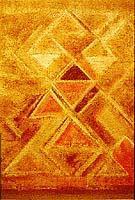
Vishwanadhan combines and recombines these basic geometrical abstractions of our traditional symbology of creation and existence into paintings after paintings, sometimes painted in concentric brushstrokes of vermillion, saffron, touches of sap green and all forms stacked up one layer over another, sometimes brushed off partially, sometimes painted in an austere range of greys and browns like the early Cubists.
The patient viewer will not miss the continuous pulsation of movements, both in terms of colour arrangement and linear directions, a changing and at the same time changeless continuum of the fabric of life. This we find in his intaglio prints with the minimum linear elements. One thing intrigues me, that is the dark ‘dots’ in them. They are to made up of raisin dust. Then comes his large combines of squares of sand of different colours—the squares or the kshetras that make rectangles which can multiply in area ad infinitum….
Pictorally they have the beauty of the physicist’s equation that carries the bewilderingly enormous range of findings in a few algebraic expressions balanced on either side... His stacked up colour horizontals sometimes overlap, sometimes leave some bright chinks or cracks of the white canvass and the small sources of pure white light change the bright tropical colours dawn in unhurried brushstrokes…

Vishwanadhan combines and recombines these basic geometrical abstractions of our traditional symbology of creation and existence into paintings after paintings, sometimes painted in concentric brushstrokes of vermillion, saffron, touches of sap green and all forms stacked up one layer over another, sometimes brushed off partially, sometimes painted in an austere range of greys and browns like the early Cubists.
The patient viewer will not miss the continuous pulsation of movements, both in terms of colour arrangement and linear directions, a changing and at the same time changeless continuum of the fabric of life. This we find in his intaglio prints with the minimum linear elements. One thing intrigues me, that is the dark ‘dots’ in them. They are to made up of raisin dust. Then comes his large combines of squares of sand of different colours—the squares or the kshetras that make rectangles which can multiply in area ad infinitum….
Pictorally they have the beauty of the physicist’s equation that carries the bewilderingly enormous range of findings in a few algebraic expressions balanced on either side... His stacked up colour horizontals sometimes overlap, sometimes leave some bright chinks or cracks of the white canvass and the small sources of pure white light change the bright tropical colours dawn in unhurried brushstrokes…
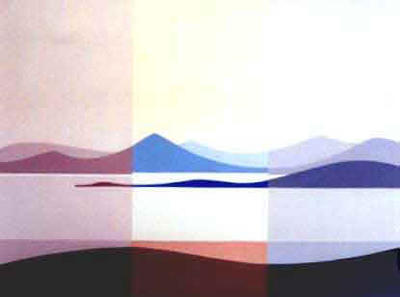
Paintings By Elisabeth Buschmann

Excerpts from the Exhibitions visitor's book:
One never saw the mystic world in such lucid simplicity.
Beautiful and enticing visualisation indeed.
Tusar N. Mohapatra
Tusar N. Mohapatra
Sunday, July 03, 2005
Semiotics, the theory and understanding of signs, suggests that a particular sign has a set of meanings, based on a systemic location and a discursive use of that sign. Every sign gains its meaning in a particular language system. Words have to be read in a given social context. Thus, for me, semiotics suggested that you could not ascribe universal values to literary texts. You had to understand the burden of interpretation and the burden of representation on those specific texts.
I am interested in the global context of the issue of global citizenship. Citizenship has largely been seen in its social, political and legal aspects. How does aesthetic and ethical experience form part of cultural citizenship? Sociologists and policy thinkers think of culture in the context of global governance and of culture as institutions. I believe cultural works ignite the issue of the cultural citizen.
In a world that is increasingly instrumentalist and consumerist, I think it is very important to set up against such a world the great aspirations of literature and poetry, of painting and music, because art and aesthetic experience adds ardour and passion to our principles and our beliefs. It should be seen as an essential part of our freedom and not an optional part of our lives.
Homi K. Bhabha
Towards a global cultural citizenship
The Hindu Literary Review [ 03.07.2005 ]
The Aesthetic
The aesthetic is in this sense the relay or transmission mechanism by which theory is converted to practice, the detour taken by ethical ideology through the feelings and senses so as to reappear as spontaneous social practice.
Terry Eagleton
The Ideology
Wednesday, June 29, 2005
The Art of the Matter
The importance of art in helping young brains develop to the fullest potential cannot be understated.
New research on the human brain shows that many of the brain's uniquely human skills were developed for and through the use of hands. Evolutionary biologists now tell us that it was the use of hands — to grasp a stick, to throw a stone or spear, to shape a pot on the wheel — which caused the brain to develop its amazing abilities of specialised processing. The brain did not come ready made with these skills. So the continued use of hands is critically important to the stimulation and childhood development of the human brain.
Frank Wilson's recent book, The Hand, describes studies that reveal this co-dependant development of the brain and the hands, particularly in brain capabilities like spatial thinking that are key to advanced fields like engineering, surgery or reading MRIs, space science, mathematics, computer programming and chip designing. Wilson tells of the experience at CALTECH, the eminent engineering school in California. Performance scores of its engineering students were rising in every important area except spatial thinking, where they were falling. As spatial thinking is vital to problem solving, particularly in emerging technologies, this was worrying. Eventually they realised this was caused by limited physical spatial hand activity.
Arts and crafts are, perhaps, one of the best ways to do this. Your future engineer or doctor should be spending much more time in hand-oriented activities — sculpture, painting, pottery, knitting, weaving, chopping vegetables and making chapattis. Reviving arts programmes in schools might be a good way to get our children to use their hands in ways that will develop vital brain skills. This must be accompanied with a concerted attempt to have children spend less time watching TV or a computer screen and more doing hand-based creative tasks. So if you are concerned parents, ask your children's schools to ensure time for creative art every school day, every year, right up to the final board exams!
We all sense that the arts are dying in schools. We are aware of problems of funding and the low priority given to arts education. This is partly because we want to make our children competent for the job market. In the ensuing drive to train children in maths, sciences and languages, we do not want to spend time and resources on what we perceive as marginally useful subjects like music and art. Teachers, parents and governing bodies — all want children to score high marks so they can get into the best colleges. I don't know how to fight this tide but I do think we need to be concerned that our children's brain and mental development is not unnecessarily stunted. If we could see that the arts will help them be better at engineering, science and medicine, then perhaps we will find ways to have them continue art.
The main reason we are so confused about the value of art is because the arts have become disassociated with everyday life. We are unable to see that the skills that develop in doing art are interrelated with our general abilities and evolutionary development. Spatial thinking, creativity, heightened concentration and perception and fine motor skills that develop in the arts are also the very mental skills needed in today's advanced professions. If we want the arts to be meaningful, we have to find a way to reintegrate art into our lives. I am reminded of Nelson Goodman's rejection of the classical question, "What is art?" and preference for, "When is art?" School art programmes need to reconnect art with the broad spectrum of human needs it has traditionally served. It must be a redesign that does not start with the Western notion of studio arts but with the more integrated Indian traditions of art making. I have been thinking about a new approach to arts education, and call it "Art from Indian Hands".
In India, one cannot but help notice the range and depth of art. It is everywhere: in the saris, shawls, kitchen utensils, household tools, festive decorations, floor and wall paintings, road shrines, toys... Perhaps the reason for this richness of visual languages is the evolution of India's cultures. Great epics and systems of philosophy, religion, medicine and law were transmitted orally. Words were largely heard and not seen. During these centuries, there developed parallel visual languages to express many of these ideas (in form, colour, geometry and symbols). This rich visual inheritance has survived and informs the making of everyday things and in meeting physical, social and psychological needs.
In Indian villages, art making is still integrated with everyday needs. Weavers, potters, storytellers, jewellery-makers, woodworkers and ironsmiths are still part of the village community. They may not necessarily make art but meet everyday needs in artful ways. They tell stories and transmit traditions and values. They are aesthetically rich. Even in urban India, hand making of art continues like the toys made on the streets of Delhi with recycled materials. Each region has developed its own visual forms and languages that reflect its history, geography and social context. Climate and availability of materials is reflected in their artwork. This depth and variety of art/craft affords a rich palette to choose from for this programme.
In the "Art from Indian Hands" programmes, children will be taken on a journey through Indian art forms that will show the integration of art with daily life in our diverse regional cultures. These will provide springboards for making art that will be relevant to contemporary children in both primary and secondary schools. The programme is not trying to get children to imitate traditional arts and crafts. That happens now and then in schools. This aims to do something much deeper — to get them to understand the languages of art and to use them afresh in their own contexts.
The schematic structure of "Art from Indian Hands" starts around a cluster of human needs and art forms that help meet them. It will look at art that meets needs for celebration (seasons, harvests, marriages, festivals, rites of passage); beauty (make-up, jewellery, clothes, body painting/mehndi); utility (cooking, storage, travel); psychological reasons (protection, identity, friendship, spirituality) and entertainment (performances, story-telling, toys, games).
As these needs are universal, the programme will encourage children to look at their own needs and to use traditional examples as springboards to create their own responses to their needs, adapting the form, language and materials to their local environment. Some examples:
Along with brain development, hand activities also foster concentration, increase attention spans and induce calmness. Jasleen Dhamija, a well-known Indian crafts historian, found that the repetitious hand movements in several Indian crafts induce a meditative quality that is linked to the body's biorhythms. Repetitious and soothing hand activities may also help children with ADD (attention deficit disorder) and ADHD (attention deficit hyperactivity disorder).
The aim of "Art from Indian Hands" is to provide art teachers, parents and children an approach and tools that will help them understand the process of making art, and that will help young brains develop to their full potential. The impact of this programme may not be immediately visible in better marks in board subjects, though that is also possible, but will be more apparent in the long-term when they go to college and eventually practise their professions.
Am I overstating the value of art making? As an artist from India who has been engaged in education, I have come to believe that the purpose of art is much larger than what is commonly understood. Art making is a fundamental human response to life and is deeply connected with brain and mind development. It is also an endeavour that helps deepen our understanding of cultures and can lead to the unifying discovery that most human needs transcend cultural differences. I wonder if schools, parent bodies or art institutions would be interested in developing such a programme?
Shakti Maira is an artist and educator. Reach him at shaktimaira@rediffmail.com
http://www.hindu.com/mag/2003/11/30/stories
SHAKTI MAIRA examines how a journey through Indian art forms will help our children.
Every parent hopes their children will develop to their fullest potential. To achieve this, parents work hard to get their children into the best schools, and push them into focusing on getting high marks in examinations. In the process they discourage children from activities like art, music and sports. Despite good intentions, they may actually be limiting their children's brain development in areas crucial to their eventual success, even in fields like engineering, medicine and science.
Every parent hopes their children will develop to their fullest potential. To achieve this, parents work hard to get their children into the best schools, and push them into focusing on getting high marks in examinations. In the process they discourage children from activities like art, music and sports. Despite good intentions, they may actually be limiting their children's brain development in areas crucial to their eventual success, even in fields like engineering, medicine and science.
New research on the human brain shows that many of the brain's uniquely human skills were developed for and through the use of hands. Evolutionary biologists now tell us that it was the use of hands — to grasp a stick, to throw a stone or spear, to shape a pot on the wheel — which caused the brain to develop its amazing abilities of specialised processing. The brain did not come ready made with these skills. So the continued use of hands is critically important to the stimulation and childhood development of the human brain.
Frank Wilson's recent book, The Hand, describes studies that reveal this co-dependant development of the brain and the hands, particularly in brain capabilities like spatial thinking that are key to advanced fields like engineering, surgery or reading MRIs, space science, mathematics, computer programming and chip designing. Wilson tells of the experience at CALTECH, the eminent engineering school in California. Performance scores of its engineering students were rising in every important area except spatial thinking, where they were falling. As spatial thinking is vital to problem solving, particularly in emerging technologies, this was worrying. Eventually they realised this was caused by limited physical spatial hand activity.
Their solution was to require all students to spend a semester in an automobile repair shop, so that they learnt to use their hands in diverse ways. Perhaps if these students had used their hands in school or home, they would have arrived at CALTECH with excellent spatial thinking skills. Young children's interest in using their hands to draw and paint, to build with blocks, to play ball are signs of this natural process of brain development. They are not just playing but also exercising and developing innate brain potential. As children grow older, we tend to lead them away from these activities and have them concentrate on reading, writing and, sadly, memorising. This is to their detriment, since it is important for their brain development to keep using their hands and imagination.
Arts and crafts are, perhaps, one of the best ways to do this. Your future engineer or doctor should be spending much more time in hand-oriented activities — sculpture, painting, pottery, knitting, weaving, chopping vegetables and making chapattis. Reviving arts programmes in schools might be a good way to get our children to use their hands in ways that will develop vital brain skills. This must be accompanied with a concerted attempt to have children spend less time watching TV or a computer screen and more doing hand-based creative tasks. So if you are concerned parents, ask your children's schools to ensure time for creative art every school day, every year, right up to the final board exams!
We all sense that the arts are dying in schools. We are aware of problems of funding and the low priority given to arts education. This is partly because we want to make our children competent for the job market. In the ensuing drive to train children in maths, sciences and languages, we do not want to spend time and resources on what we perceive as marginally useful subjects like music and art. Teachers, parents and governing bodies — all want children to score high marks so they can get into the best colleges. I don't know how to fight this tide but I do think we need to be concerned that our children's brain and mental development is not unnecessarily stunted. If we could see that the arts will help them be better at engineering, science and medicine, then perhaps we will find ways to have them continue art.
The main reason we are so confused about the value of art is because the arts have become disassociated with everyday life. We are unable to see that the skills that develop in doing art are interrelated with our general abilities and evolutionary development. Spatial thinking, creativity, heightened concentration and perception and fine motor skills that develop in the arts are also the very mental skills needed in today's advanced professions. If we want the arts to be meaningful, we have to find a way to reintegrate art into our lives. I am reminded of Nelson Goodman's rejection of the classical question, "What is art?" and preference for, "When is art?" School art programmes need to reconnect art with the broad spectrum of human needs it has traditionally served. It must be a redesign that does not start with the Western notion of studio arts but with the more integrated Indian traditions of art making. I have been thinking about a new approach to arts education, and call it "Art from Indian Hands".
In India, one cannot but help notice the range and depth of art. It is everywhere: in the saris, shawls, kitchen utensils, household tools, festive decorations, floor and wall paintings, road shrines, toys... Perhaps the reason for this richness of visual languages is the evolution of India's cultures. Great epics and systems of philosophy, religion, medicine and law were transmitted orally. Words were largely heard and not seen. During these centuries, there developed parallel visual languages to express many of these ideas (in form, colour, geometry and symbols). This rich visual inheritance has survived and informs the making of everyday things and in meeting physical, social and psychological needs.
In Indian villages, art making is still integrated with everyday needs. Weavers, potters, storytellers, jewellery-makers, woodworkers and ironsmiths are still part of the village community. They may not necessarily make art but meet everyday needs in artful ways. They tell stories and transmit traditions and values. They are aesthetically rich. Even in urban India, hand making of art continues like the toys made on the streets of Delhi with recycled materials. Each region has developed its own visual forms and languages that reflect its history, geography and social context. Climate and availability of materials is reflected in their artwork. This depth and variety of art/craft affords a rich palette to choose from for this programme.
In the "Art from Indian Hands" programmes, children will be taken on a journey through Indian art forms that will show the integration of art with daily life in our diverse regional cultures. These will provide springboards for making art that will be relevant to contemporary children in both primary and secondary schools. The programme is not trying to get children to imitate traditional arts and crafts. That happens now and then in schools. This aims to do something much deeper — to get them to understand the languages of art and to use them afresh in their own contexts.
The schematic structure of "Art from Indian Hands" starts around a cluster of human needs and art forms that help meet them. It will look at art that meets needs for celebration (seasons, harvests, marriages, festivals, rites of passage); beauty (make-up, jewellery, clothes, body painting/mehndi); utility (cooking, storage, travel); psychological reasons (protection, identity, friendship, spirituality) and entertainment (performances, story-telling, toys, games).
As these needs are universal, the programme will encourage children to look at their own needs and to use traditional examples as springboards to create their own responses to their needs, adapting the form, language and materials to their local environment. Some examples:
In Gujarat, the need to carry money securely is met by making nolos (pouches). The story of the nolo in words and pictures will show how they were made and adorned. Then a demonstration of how a modern nolo can be made, using commonly available materials so that children end up with money belts that work, and also tell their story. In Bihar, travelling storytellers carry picture scrolls that meet the needs of a compelling presentation. We will show examples of these and how they were made. The children will be encouraged to write (or find) a story, which they will illustrate in a picture scroll and then tell aloud about issues of concern for them, like HIV/AIDS prevention, environmental protection... whatever. In Bengal, the need to make a passage or entrance special is met by making floor and wall paintings called alpanas. Children will be encouraged to use this language with classroom materials — clay, poster paint to celebrate a rite of passage such as school graduation.
Along with brain development, hand activities also foster concentration, increase attention spans and induce calmness. Jasleen Dhamija, a well-known Indian crafts historian, found that the repetitious hand movements in several Indian crafts induce a meditative quality that is linked to the body's biorhythms. Repetitious and soothing hand activities may also help children with ADD (attention deficit disorder) and ADHD (attention deficit hyperactivity disorder).
The aim of "Art from Indian Hands" is to provide art teachers, parents and children an approach and tools that will help them understand the process of making art, and that will help young brains develop to their full potential. The impact of this programme may not be immediately visible in better marks in board subjects, though that is also possible, but will be more apparent in the long-term when they go to college and eventually practise their professions.
Am I overstating the value of art making? As an artist from India who has been engaged in education, I have come to believe that the purpose of art is much larger than what is commonly understood. Art making is a fundamental human response to life and is deeply connected with brain and mind development. It is also an endeavour that helps deepen our understanding of cultures and can lead to the unifying discovery that most human needs transcend cultural differences. I wonder if schools, parent bodies or art institutions would be interested in developing such a programme?
Shakti Maira is an artist and educator. Reach him at shaktimaira@rediffmail.com
http://www.hindu.com/mag/2003/11/30/stories
The Golden Light
Thy golden Light came down into my brain
And the grey rooms of mind sun-touched became
A bright reply to Wisdom's occult plane,
A calm illumination and a flame.
Thy golden Light came down into my throat,
And all my speech is now a tune divine,
A paean-song of Thee my single note;
My words are drunk with the Immortal's wine.
Thy golden Light came down into my heart
Smiting my life with Thy eternity;
Now has it grown a temple where Thou art
And all its passions point towards only Thee.
Thy golden Light came down into my feet,
My earth is now Thy playfield and Thy seat.
Sri Aurobindo
8-8-1938
(Revised 22-3-1944)
http://www.poetseers.org/the_poetseers/sri_aurobindo/the_sonnets
And the grey rooms of mind sun-touched became
A bright reply to Wisdom's occult plane,
A calm illumination and a flame.
Thy golden Light came down into my throat,
And all my speech is now a tune divine,
A paean-song of Thee my single note;
My words are drunk with the Immortal's wine.
Thy golden Light came down into my heart
Smiting my life with Thy eternity;
Now has it grown a temple where Thou art
And all its passions point towards only Thee.
Thy golden Light came down into my feet,
My earth is now Thy playfield and Thy seat.
Sri Aurobindo
8-8-1938
(Revised 22-3-1944)
http://www.poetseers.org/the_poetseers/sri_aurobindo/the_sonnets
Subscribe to:
Posts (Atom)